

B01:Dynamics simulation of metal ion for solvation and coordination with proteins
Hiroshi WATANABE
(Quantum Computing Center, Keio University)
Lab website

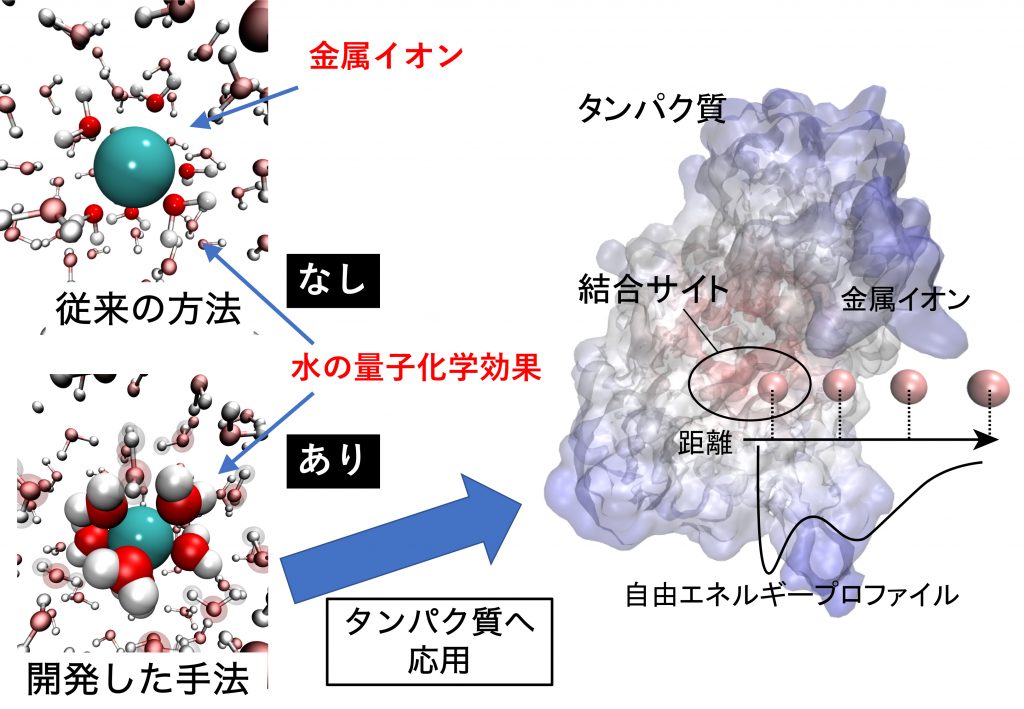
The metal recognition principles behind metal selectivity/non-selectivity in various metalloproteins are critical elements in understanding and controlling metal dynamics. Since molecular simulations can access information at the atomic/molecular level, they are expected to contribute to the elucidation of these principles from the micro level. In general, when discussing ligand binding of proteins, it is necessary to consider not only the coordination state with proteins but also the hydration and the dynamics of incorporation into the protein. Since the transition metal ion is strongly coordinated with the water molecule, it is necessary to consider not only the solute ion but also the quantum chemical effects of water. In recent years, we have proposed and developed a new computational framework and succeeded in incorporating the quantum chemical effects of solvation. In this study, we extend our method to handle transition metal ions, aiming to create a theoretical basis for the hydration dynamics of metal ions in solution and uptake by proteins.
Major publications
H. C. Watanabe, T. Kubar, M.Elstner
“Size-consistent multipartitioning QM/MM: A stable and efficient adaptive QM/MM method”
Journal of Chemical Theory and Computation 2014, 10, 4242-4252
doi: 10.1021/ct5005593
H. C. Watanabe, M. Banno, M. Sakurai
“An adaptive quantum mechanics/molecular mechanics method for the infrared spectrum of water: incorporation of the quantum chemical effect between solute and solvent”
Physical Chemistry Chemical Physics 2016, 18, 7318-7333
doi: 10.1039/c5cp07136d
H. C. Watanabe, M. Kubillus, T. Kubar, R. Stach, B. Mizaikoff, H. Ishikita
“Cation solvation with quantum chemical effects modeled by a size-consistent multipartitioning quantum mechanics/molecular mechanics method”
Physical Chemistry Chemical Physics 2017, 19, 17985-17997
doi: 10.1039/c7cp01708a
H. C. Watanabe, Y. Yamashita , H. Ishikita
“Electron transfer pathways in a multiheme cytochrome MtrF”
Proceedings of the National Academy of Sciences, 2017, 114, 2916-2921
doi: 10.1073/pnas.1617615114
H. C. Watanabe, Q. Cui
“Quantitative analysis of QM/MM boundary artifacts and correction in adaptive QM/MM simulations”
Journal of Chemical Theory and Computation 2019, 15, 3917-3928
doi: 10.1021/acs.jctc.9b00180