

A01:Elucidation of the dynamics control mechanism of essential trace element “selenium”
Yoshiro SAITO
(Graduate School of Pharmaceutical Sciences, Tohoku University)
Lab website

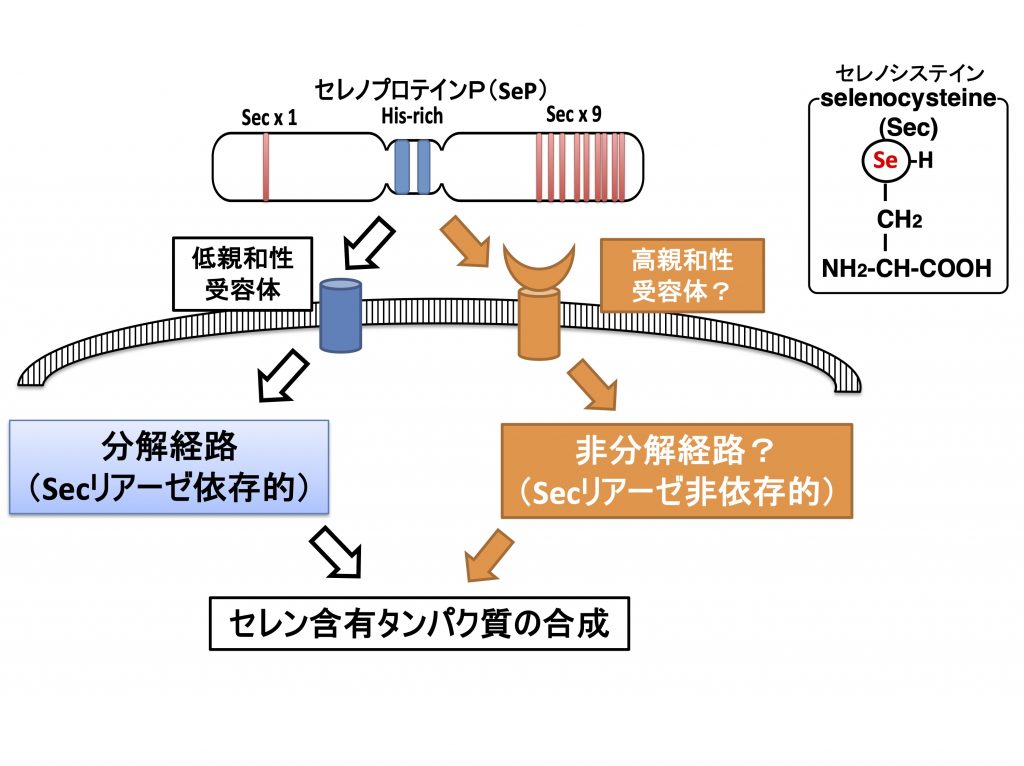
Selenoprotein P (SeP) is the major selenium-containing protein in plasma. We have revealed that SeP functions as a selenium-transport protein to deliver selenium to cells. SeP has been shown to preferentially transport selenium to the brain, testis, and lymphocytes; however, the details are not clear. Recently, we have revealed that the selenium transport efficiency of SeP varies greatly depending on the type of cultured cells. For efficient cells, “dynamic selenium-transport mechanism that removes only selenium from SeP” was assumed. In this study, we aim to elucidate the newly discovered selenium-transport mechanism. SeP receptors expressed in each cell are compared to clarify differences in affinity for SeP, and interacting factors are identified. After the incorporation into cells, we identify vesicles and coexisting molecules and clarify the dynamic selenium-transfer mechanism. In addition, we will clarify the structural change of SeP after selenium transportation. Based on these studies, we will clarify a novel mechanism of selenium transport via SeP and propose a new concept of selenium control mechanism in vivo.
Major publications
Y. Mita, K. Nakayama, S. Inari, Y. Nishito, Y. Yoshioka, N. Sakai, K. Sotani, T. Nagamura, Y. Kuzuhara, K. Inagaki, M. Iwasaki, H. Misu, M. Ikegawa, T. Takamura, N. Noguchi, and Y. Saito
“Selenoprotein P-neutralizing antibodies improve insulin secretion and glucose sensitivity in type 2 diabetes mouse models”
Nature Commun 2017, 8, 1658
doi: 10.1038/s41467-017-01863-z
H. Misu, H. Takayama,Y. Saito, Y. Mita, A. Kikuchi, K. Ishii, K. Chikamoto, T. Kanamori, N. Tajima, F. Lan, Y. Takeshita, M. Honda, M. Tanaka, S. Kato, N. Matsuyama, Y. Yoshioka, K. Iwayama, K. Tokuyama, N. Akazawa, S. Maeda, K. Takekoshi, S. Matsugo, N. Noguchi, S. Kaneko, and T. Takamura
“Deficiency of the hepatokine selenoprotein P increases responsiveness to exercise in mice through upregulation of ROS and AMPK in muscle”
Nature Med 2017, 23, 508-516
doi: 10.1038/nm.4295
Y. Saito, M. Shichiri, T. Hamajima, N. Ishida, Y. Mita, S. Nakao, Y. Hagihara, Y. Yoshida, K. Takahashi, E. Niki, and N. Noguchi
“Enhancement of lipid peroxidation and its amelioration by vitamin E in a subject with mutations in the SBP2 gene”
J Lipid Res 2015, 56, 2172-2182
doi: 10.1194/jlr.M059105
Y. Saito, N. Sato, M. Hirashima, G. Takebe, S. Nagasawa and K. Takahashi
“Domain structure of bi-functional selenoprotein P”
Biochem J 2004, 381, 841-846
doi:10.1042/BJ20040328
Y. Saito, T. Hayashi, A. Tanaka, Y. Watanabe, M. Suzuki, E. Saito and K. Takahashi
“Selenoprotein P in Human Plasma as an Extracellular Phospholipid Hydroperoxide Glutathione Peroxidase. Isolation and Enzymatic Characterization of Human Selenoprotein P”
J Biol Chem 1999, 274, 2866-2871
doi:10.1074/jbc.274.5.2866