

A01:Lysosomal biometal regulation and signal transduction
Yosuke FUNATO
(Research Institute for Microbial Diseases, Osaka University)
Lab website

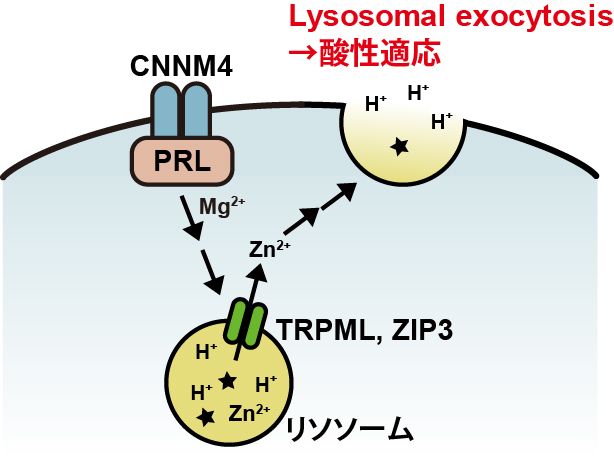
Among trace metal elements, zinc is known to be involved in signal transduction. Recent reports also show that zinc is stored in lysosomes, but whether lysosomal zinc participates in signal transduction has remained unknown. We found that overexpression of PRL, a driver of cancer malignancy, promotes lysosomal exocytosis, a fusion of lysosomes with plasma membrane and subsequent release of their ingredients, such as condensed H+. We also revealed that this phenomenon alters the cellular response to environmental pH and make cells optimized to acidic environment observed in malignant cancer tissues, and that TRPML1 and ZIP3, exporters of zinc from lysosomes, are necessary. These results suggest that lysosome-stored zinc plays as a “signal” and promote lysosomal exocytosis and acid adaptation, and in this study we demonstrate the importance of lysosomal zinc as a signal messenger by exploring the molecular mechanism of this phenomenon.
Major publications
O. Hashizume, #Y. Funato, D. Yamazaki, #H. Miki (#: co-correspondence)
“Excessive Mg2+ Impairs Intestinal Homeostasis by Enhanced Production of ATP and Reactive Oxygen Species.”
Antioxid Redox Signal. In press
doi: 10.1089/ars.2019.7951
#I. Gulerez, #Y. Funato, H. Wu, M. Yang, G. Kozlov, H. Miki, K. Gehring (#: co-first)
“Phosphocysteine in the PRL-CNNM pathway mediates magnesium homeostasis.”
EMBO Rep. 2016, 17, 1890-1900
doi: 10.15252/embr.201643393
Y. Funato, D. Yamazaki, S. Mizukami, L. Du, K. Kikuchi, H. Miki.
“Membrane protein CNNM4-dependent Mg2+ efflux suppresses tumor progression.”
J. Clin. Invest. 2014, 124, 5398-5410
doi: 10.1172/JCI76614