

A02:Molecular structural dynamics of pathogenic metalloproteins in postmortem brain in dementias
Tadayuki OGAWA
(Graduate School of Medicine, The University of Tokyo)
Researchgate

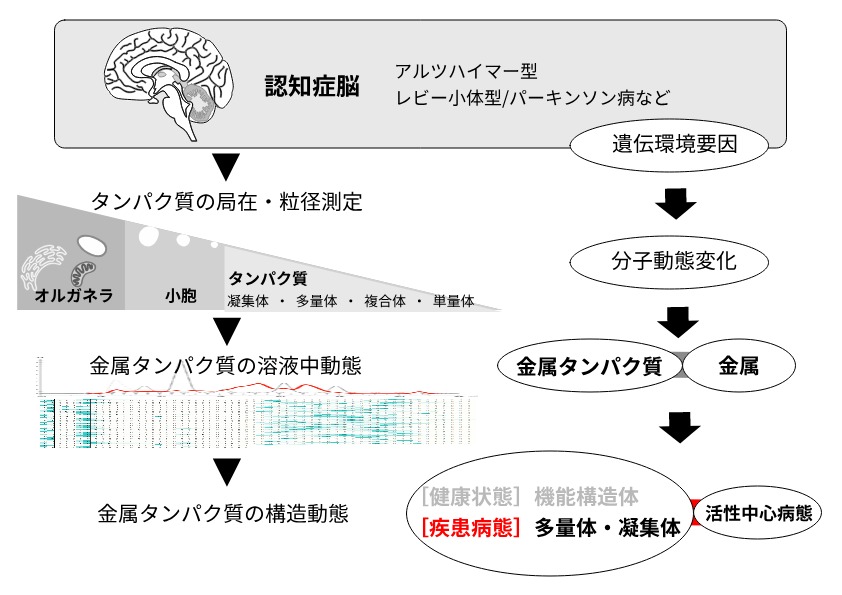
To date, the multimerization and aggregation of pathogenic proteins have been reported in some types of dementia. However, there are only a few key proteins reported as critical candidates to display the pathogenic molecular dynamics in the disease conditions. This research project will uncover the specific pathogenic molecules through integrated multi-level analyses from the postmortem brains of patients of dementia (Alzheimer’s disease, Parkinson’s disease, dementia with Lewy bodies) to the molecular dynamics of pathogenic metalloproteins and bio-metals. As fruits of this research project, we will know the critical pathological molecular dynamics that can explain much clearly about the pathogenesis and specific biomarkers of dementia.
Major publications
Toyoshima M, Jiang X, Ogawa T, Ohnishi T, Yoshihara S, Balan S, Yoshikawa T, Hirokawa N.
“Enhanced carbonyl stress induces irreversible multimerization of CRMP2 in schizophrenia pathogenesis.”
Life Sci Alliance. 2019 Oct 7;2(5). pii:e201900478.
doi: 10.26508/lsa.201900478
Ogawa T, Saijo S, Shimizu N, Jiang X, Hirokawa N.
“Mechanism of Catalytic Microtubule Depolymerization via KIF2-Tubulin Transitional Conformation.”
Cell Rep. 2017 Sep 12;20(11):2626-2638.
doi: 10.1016/j.celrep.2017.08.067
Ogawa T, Hirokawa N.
“Microtubule Destabilizer KIF2A Undergoes Distinct Site-Specific Phosphorylation Cascades that Differentially Affect Neuronal Morphogenesis.”
Cell Rep. 2015 Sep 22;12(11):1774-88.
doi: 10.1016/j.celrep.2015.08.018
Ichinose S, Ogawa T, Hirokawa N.
“Mechanism of Activity-Dependent Cargo Loading via the Phosphorylation of KIF3A by PKA and CaMKIIa.”
Neuron. 2015 Sep 2;87(5):1022-35.
doi: 10.1016/j.neuron.2015.08.008
Ogawa T, Nitta R, Okada Y, Hirokawa N.
“A common mechanism for microtubule destabilizers-M type kinesins stabilize curling of the protofilament using the class-specific neck and loops.”
Cell. 2004 Feb 20;116(4):591-602.
doi: 10.1016/S0092-8674(04)00129-1