
A02:Evolution and functional analysis of bacterial metal transport system against nutrient immunity
Ichiro Nakagawa
(Dept. of Microbiology, Graduate School of Medicine, Kyoto University)
Lab website

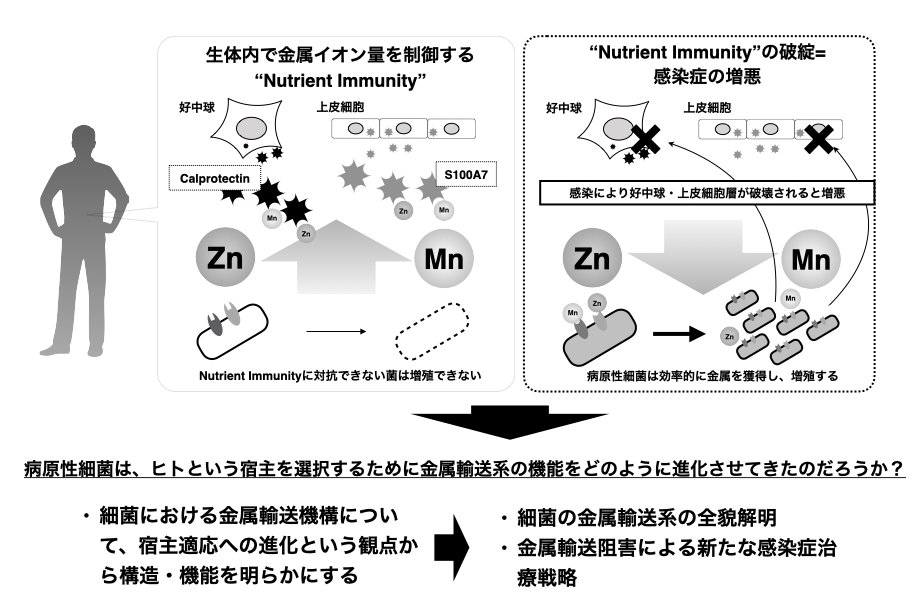
Since bacteria adapt to extremely diverse environments on the earth, it is thought that they have evolved independently according to the environment. Therefore, the metal-acquiring system and excretion system of these bacteria are very important factors that determine the niche of the bacteria. It is known that metal elements such as iron, zinc, and manganese are essential for the so-called “pathogenic gene expression induction mechanism” that is the key to the expression of pathogenicity by bacteria, but in humans and other living bodies, There is a mechanism called nutrient immunity that inhibits the acquisition of essential metals in bacterial species. In response to this, pathogenic bacteria have evolved their high-affinity metal transport system to exert pathogenicity in vivo, and as a result, they have a unique metal transport system depending on the environment. However, little research has been done on the question of “how the metal transport system evolves at the genus/species level of bacteria to adapt to the host and participate in pathogenicity”. In this study, we will clarify how evolutionary aspects of pathogenic bacteria have evolved the function of the metal transport system to select the host. I would like to elucidate the functional importance of the metal transport system in the adaptation of pathogenic bacteria to the host.
Major Publications
I. Nakagawa, K. Kurokawa, A. Yamashita, M. Nakata, Y. Tomiyasu, N. Okahashi, S. Kawabata, K. Yamazaki, T. Shiba, T. Yasunaga, H. Hayashi, M. Hattori, S. Hamada
“Genome Sequence of an M3 Strain of Streptococcus pyogenes Reveals a Large-Scale Genomic Rearrangement in Invasive Strains and New Insights into Phage Evolution”
Genome Res. 13: 1042-1055, 2003
doi: 10.1101/gr.1096703
I. Nakagawa, A. Amano, N. Mizushima, A. Yamamoto, H. Yamaguchi, T. Kamimoto, A. Nara, J. Funao, M. Nakata, K. Tsuda, S. Hamada, T. Yoshimori
“Autophagy defends cells against invading group A Streptococcus. Science”
Science 306: 1037-40, 2004
doi: 10.1126/science.1103966
Y. Yoshikawa, M. Ogawa, I. Nakagwa, C. Sasakawa
“Listeria monocytogenes ActA-mediated escape from autophagic recognition”
Nat. Cell. Biol 11: 1233-1240, 2009
doi: 10.1038/ncb1967
A. Minowa-Nozawa, T. Nozawa, K. Okamoto-Furuta, H. Kohda, I. Nakagawa
“Rab35 GTPase recruits NDP52 to autophagy targets”
EMBO J. 36: 2790-2807, 2018
doi: 10.15252/embj.201796463
T. Nozawa, S. Sano, A. Minowa-Nozawa, H. Toh, S. Nakajima, K. Murase, C. Aikawa, I. Nakagawa
“TBC1D9 regulates TBK1 activation through Ca2+ signaling in selective autophagy”
Nat. Commun. 11: 770, 2020
doi: 10.1038/s41467-020-14533-4