

A02:Identification of responsible gene(s) and elucidation of pathophysiological significance for copper accumulation in the brain with Down syndrome
Keiichi ISHIHARA
(Department of Pathological Biochemistry, Kyoto Pharmaceutical University)
Lab website

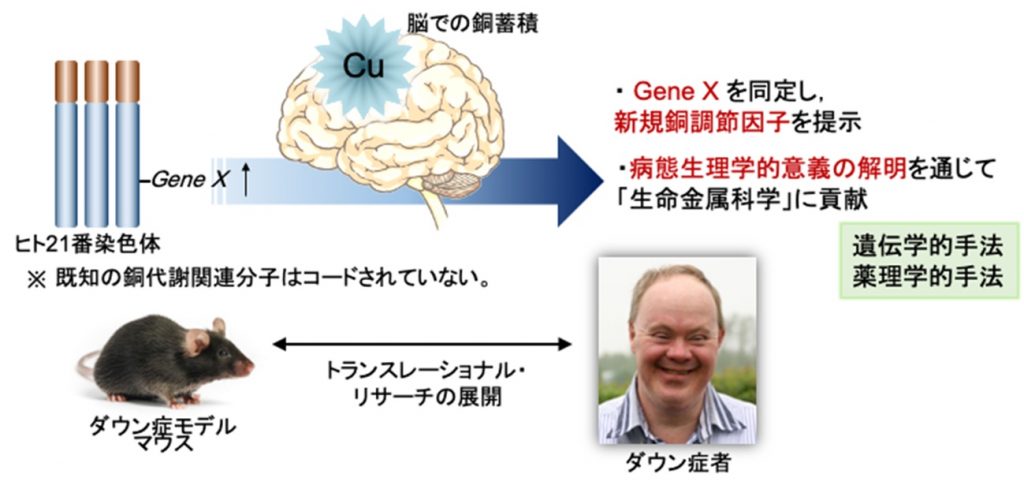
Down syndrome (DS) characterized by the presence of an extra chromosome 21 is the most common cause of intellectual disability in children, even though its molecular mechanism still remains unknown. We have utilized a mouse model of DS to unravel the molecular mechanisms underlying the DS intellectual disability. In the brain of a mouse model for DS, we found that copper was abnormally accumulated, and that enhancement of oxidative stress and accumulation of phosphorylated tau protein were caused by the accumulation of copper. In our research project, we therefore pursue to identify responsible gene and to elucidate the pathophysiological significance for the copper accumulation in the brain of a DS mouse model. Since no genes related to copper dynamics are coded in the trisomic region of a DS mouse model, it is expected that we can provide a new regulator of copper dynamics. A goal of the research project is to define that DS intellectual disability is based on a disturbance of copper dynamics.
Major publications
K. Ishihara, E. Kawashita, R. Shimizu, K. Nagasawa, H. Yasui, H. Sago, K. Yamakawa, S. Akiba
“Copper accumulation in the brain causes the elevation of oxidative stress and less anxious behavior in Ts1Cje mice, a model of Down syndrome.”
Free Radical Biology and Medicine 2019, 134, 248-259
doi: 10.1016/j.freeradbiomed.2019.01.015
A. Shimohata, K. Ishihara, S. Hattori S, H. Miyamoto, H. Morishita, G. Ornthanalai, M. Raveau, AS. Ebrahim, K. Amano, K. Yamada, H. Sago, S. Akiba, N. Mataga, NP. Murphy, Y. Miyakawa, K. Yamakawa.
“Ts1Cje Down syndrome model mice exhibit environmental stimuli-triggered locomotor hyperactivity and sociability concurrent with increased flux through central dopamine and serotonin metabolism.”
Experimental Neurology 2017, 293, 1-12
doi: 10.1016/j.expneurol.2017.03.009
M. Raveau M, T. Nakahari, S. Asada, K. Ishihara, K. Amano, A. Shimohata, H. Sago, K. Yamakawa
“Brain ventriculomegaly in Down syndrome mice is caused by Pcp4 dose-dependent cilia dysfunction.”
Human Molecular Genetics 2017, 26, 923-931
doi: 10.1093/hmg/ddx007
K. Ishihara, K. Amano, AS. E. Takaki, Ebrahim, A. Shimohata, N. Shibazaki, I. Inoue, M. Takaki, Y. Ueda, H. Sago, CJ. Epstein, K. Yamakawa
“Increased lipid peroxidation in Down’s syndrome mouse models.”
Journal of Neurochemistry 2009, 110, 1965-1976
doi:10.1111/j.1471-4159.2009.06294.x