

A03:Disruption of redox homeostasis by biological-metal and harmful-metal interaction
Takashi TOYAMA
(Graduate School of Pharmaceutical Sciences, Tohoku University)
Lab website

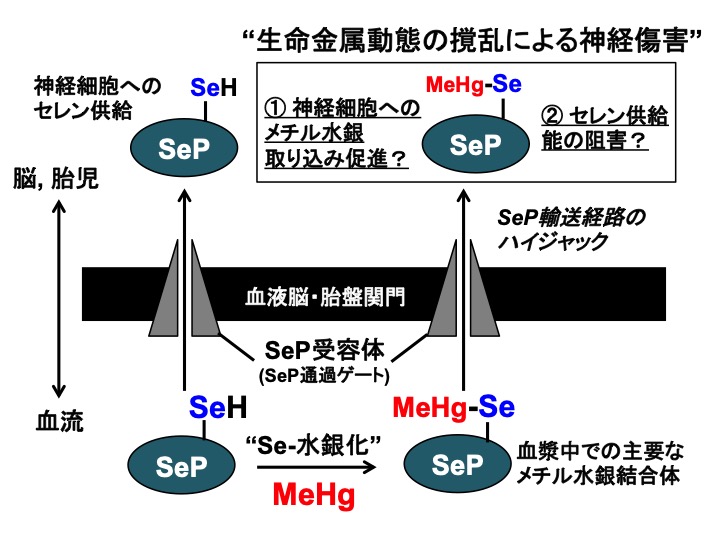
Selenoprotein P (SeP), a major selenoprotein in plasma, holds essential bio-metal selenium as selenocysteine and efficiently supplies the metal to the brain and fetus over the blood-organ barriers via the receptors for SeP. Recently, it has been reported that methylmercury (MeHg), a toxic-metal that causes central nervous dysfunctions in fetus (and also adult), circulates in the blood stream with binding to selenocysteines of SeP in plasma. These suggest that MeHg hijacking SeP and jailbreaking the blood-organ barriers like Trojan horse, and this may be contribute to the toxicity of MeHg. Our preliminary study also suggested that efficiency of selenium supplementation by SeP to neuronal cells was significantly inhibited by MeHg may be due to the strong binding with selenocysteine and MeHg. In this research, we will approach these novel hypotheses with original methodologies based on chemical biology.
Major publications
T. Toyama, Y. Shinkai, A. Yasutake, K. Uchida, M. Yamamoto, Y. Kumagai
“Isothiocyanates reduce mercury accumulation via an Nrf2-dependent mechanism during exposure of mice to methylmercury”
Environmental Health Perspectives 2011, 119, 1117-1122
doi: 10.1289/ehp.1003123
T. Toyama, Y. Shinkai, T. Kaji, Y. Kumagai
“A convenient method to assess chemical modification of protein thiols by electrophilic metals”
Journal of Toxicological Sciences 2013, 38, 477-484
doi: 10.2131/jts.38.477
A. Nishimura, K. Shimoda, T. Tanaka, T. Toyama, K. Nishiyama, Y. Shinkai, T. Numaga-Tomita, D. Yamazaki, Y. Kanda, T. Akaike, Y. Kumagai, M. Nishida
“Depolysulfidation of Drp1 induced by low-dose methylmercury exposure increases cardiac vulnerability to hemodynamic overload”
Science signaling 2019, 12, eaaw1920
doi: 10.1126/scisignal.aaw1920