

A03:Study on sex difference of manganese neurotoxicity focusing on the relationship between estrogen and manganese dynamics
Yasuhiro ISHIHARA
(Graduate School of Integrated Sciences for Life, Hiroshima University)
Lab website

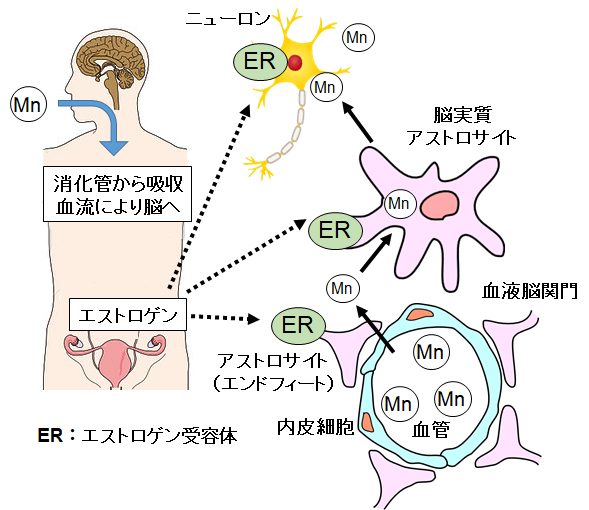
Estrogen, a female hormone, is well known to be mainly produced from ovarian granulosa cells and plays an important role in sexual maturation and pregnancy. The brain is one of the targets of estrogen, and in addition, recently it was revealed that the brain itself synthesizes a lot of kinds of steroid hormones including estrogen. At present, the role of estrogen in the nervous system has been investigated actively. We have previously shown that hippocampal estrogen has protective effects against exposure to environmental heavy metals such as tin and mercury. Hippocampal estrogen suppress inflammation, attenuate the production of reactive oxygen species, and activate survival signals such as Akt to protect neurons. In this study we challenge protective action of estrogen in manganese neurotoxicity focusing on the interaction between estrogen and manganese transporter to explain the sex difference of neuronal damages by manganese exposure.
Major publications
Ishihara Y, Itoh K, Oguro A, Chiba Y, Ueno M, Tsuji M, Vogel CFA, Yamazaki T
“Neuroprotective activation of astrocytes by methylmercury exposure in the inferior colliculus”
Sci Rep 2019, 9, 13899
doi: 10.1038/s41598-019-50377-9
Ishihara Y, Takemoto T, Ishida A, Yamazaki T
“Protective actions of 17β-estradiol and progesterone on oxidative neuronal injury induced by organometallic compounds”
Oxid Med Cell Longev 2015, 2015, 343706
doi: 10.1155/2015/343706
Ishihara Y, Itoh K, Ishida A, Yamazaki T
“Selective estrogen-receptor modulators suppress microglial activation and neuronal cell death via an estrogen receptor-dependent pathway”
J Steroid Biochem Mol Biol 2015, 145, 85–93
doi: 10.1016/j.jsbmb.2014.10.002
Ishihara Y, Fujitani N, Kawami T, Adachi C, Ishida A, Yamazaki T
“Suppressive effects of 17β-estradiol on tributyltin-induced neuronal injury via Akt activation and attenuation of oxidative stress in rat hippocampal slices.”
Life Sci 2014, 99, 24-30
doi: 10.1016/j.lfs.2014.01.061
Ishihara Y, Kawami T, Ishida A, Yamazaki T
“Protective effects of progesterone on tributyltin-induced neuronal injury in rat hippocampal slices”
J Steroid Biochem Mol Biol 2013, 135, 1-6
doi: 10.1016/j.jsbmb.2012.12.013